Category:
Recruiting
Q: What resources do I get for recruiting?
A:
Your recruiting resources are based on how many scholarships you have open and the division you are in. You're given separate budgets for each scouting and recruiting
Scouting:
Division 1: 35K + 4K per Opening
Division 2: 25K + 3K per Opening
Division 3: 15K + 2K per Opening
Recruiting:
Division 1: 5K + 3K per Opening
Division 2: 3K + 2K per Opening
Division 3: 1K + 1K per Opening
Recruiting Attention Points:
20 + 20 per Opening
Note: The max number of openings considered for resources is 6 open scholarships. If, for example, you have 8 open scholarships you would still receive the same amount of resources as if you had 6 open scholarships.
You only get half of the resources for a scholarship opened due to an unfulfilled promise. Also, you will not get resources for rescinding the scholarship of a player you recruited.
Q: How often should I expect to hear from a recruit?
A: You'll only hear from a recruit when you've opened up an action (home visits, campus visit, scholarship, etc.)
Q: Can I recruit before or after the official recruiting period?
A: Once scouting starts you can scout players until recruiting has ended. Recruiting can only be done during the recruiting periods.
Q: How does the eligibility process work? Can I still recruit players that are currently ineligible by WCAA standards?
A: Not all players will pass the WCAA Initial Eligibility Clearinghouse requirements.
What that means is that for DI and DII recruits, they must meet both GPA and SAT
score requirements. In DI and DII, the requirements are on a sliding scale, the
lower the GPA, the higher the SAT score requirement. To play at DIII,
the recruit must only have a high school GPA of 2.0 or higher.
If a recruit does not qualify, he may or may not still attend your school as they
have to pay their own way the first year. They can not be on scholarship and they
can not practice (although they will reserve a scholarship for the next season).
At DI schools, the player will only have 3 years of eligibility (depending on their
collegiate gpa, they may be granted a 4th year of eligibility if they maintain a
2.7 cumulative GPA or higher) - in both situations, if they choose to play their
4 year of eligibility they will be playing as 5th year Seniors. At DII schools,
the player will have 4 years of eligibility. In both situations, they will be eligible
to play beginning with their sophomore year, assuming they have a cumulative GPA
of 2.0 or higher after their freshman year.
A recruits profile will show if they are eligible or not according to the Clearinghouse
requirements - keep in mind that the Clearinghouse only governs DI and DII schools.
A player who is listed as ineligible may still be eligible to play immediately in
DIII. Recruits who are not eligible will be taking the SAT throughout the season
leading up to the next recruiting period. If you are watching that recruit, you
will be notified by your assistant coach if he becomes eligible.
Q: Could a recruit (who is considering my school among others) select my school even if I didn't have him visit my campus?
A: Yes, not every recruit will require a campus visit.
Q: If I have 4 scholarships, can I spend all of my resources on just one really good recruit?
A: Yes, but you take a big risk with this strategy. If you don't sign the player, you're left with 4 walk-ons which could have a ripple effect into your program for seasons to come.
Q: If I offer a recruit a scholarship, does it stay on the table or do I need to reoffer it if he rejects?
A: Scholarships remain 'on the table' until one of the following happens: the recruit accepts your offer, the recruit accepts someone else's offer, the scholarship offer is withdrawn by you or the recruit rejects your offer.
Q: Can I withdraw a scholarship offer that's on the table?
A: Yes. As long as the recruit has not already accepted the offer, you may withdraw the offer. There is no cost to withdraw a scholarship offer.
Withdrawing a Scholarship will have a large negative impact on the recruit you are targeting. It will be very difficult to re-recruit a player after you withdraw a scholarship. It should not be done unless absolutely necessary.
Q: What happens if I run out of cash and haven't signed any recruits?
A: It's possible to sign a recruit without spending any cash, just using attention points.
There is no requirement to give out all of your available scholarships. Any roster spots not filled will be filled with scholarship players signed by the SimAI or will automatically be filled with walk-on players as soon as the recruiting period ends. Scholarships will be available the following season. Walk-ons will only be available for a single season unless you offer them a scholarship at some point before the next season's recruiting period begins.
Q: How many players will I have to recruit? How many total scholarships do I have available?
A: That number will vary by school. When you initially accept the job, you will see the number of scholarships available. As you progress through subsequent seasons at that school, you'll have various numbers of scholarships to fill as kids graduate, transfer, quit, leave early for the NBA, etc. Each school has 12 potential scholarships to fill each season.
Q: What happens if I don't use all of my recruiting budget?
A: Recruiting resources are only for that season - any not used are lost and not preserved for the next season.
Q: What if I offer my 2 remaining scholarships to 10 players and the 2 players I wanted least end up accepting my offer first?
A: Tough luck - it's a signed agreement between the school and the player. If you don't want to enter into that situation, just offer your first two choices their scholarships first and wait for a response. If they say no, work your way down your list.
Q: Does the success of my program impact the quality and quantity of our recruits?
A: Yes, the more success your program enjoys, the easier it will become to land recruits in the future. Conversely, if your program tanks for a couple of seasons or falls under WCAA investigation (just as examples), you may find getting kids to come to your school very challenging.
Q: What if I guarantee a recruit a starting spot, then I dont give it to him? Same with minutes, what if I dont give him his promised time? Are there any repercussions?
A: Yes, there could be. Players who are promised either a starting spot (and then are not started) or a certain amount of playing time (and don't receive it) will most likely lose Work Ethic and could end up quitting the team.
Q: I'm coaching in Division III, what are the odds of landing a DI type of player - maybe even someone that's ranked?
A: It is possible but not very likely. You cannot sign a player that is projected at a higher level during the first recruiting window. However, it is possible to sign in the second window depending on how much effort other schools have put into the recruit.
Q: Is there any signficance to the order of the schools that the recruit is considering?
A: No, the order of the schools doesn't matter.
Q: If my program is doing well (or poorly), does that impact how easy (or hard) recruiting will be in subsequent seasons?
A: Yes, schools can build reputations of success which in turn impact the recruiting process. In addition, the reputation and success of the coach also plays a role in the recruiting process.
Q: I went to a recruit's house but he wasn't there - why didn't I get my money back?
A: Some kids will stiff you if they don't think enough of you and/or your program to remember the meeting. You've still had to make the trip so you don't get your money back. The moral of the story is to not spend your high cost recruiting items on recruits unless you're confident they have a high level of interest.
Q: Do recruits become "easier" to recruit as the recruiting window begins to close?
A: Yes, and no. It depends on whether the recruit is considering any schools. Recruits that don't receive the interest they thought they would receive will be more open to playing at less prestigious schools - maybe even at a lower division than they were initially projected to play at. The further into the recruiting period it gets, the more desperate the recruits become.
Q: What factors do recruits consider besides the amount of attention they receive in recruiting?
A: Recruits look at not only the amount of attention they are given but also the school that's doing the wooing. More successful schools have an easier time of recruiting than do schools that have a losing tradition and/or have been on probation. Recruits also need to decide which school is a better fit for them - who's offering starting spots, guaranteeing playing time, etc.
Q: If I rescind a scholarship, will I get additional recruiting resources?
A: No, if you signed the player. Otherwise you will get resources.
Q: If I have 1 recruiting spot open and I have 2 guys considering only me, how do you determine which one signs?
A: At that point it's not up to you - it's up to which recruit accepts first. Be careful about doing this unless you're happy signing either player.
Q: Do AI-controlled teams recruit like humans?
A: Yes, SimAI schools do recruit like normal coaches. However, they aren't that smart and should be able to be out-recruited by teams coached by users.
Q: What is the Future Stars Scouting Service?
A: The scouting service allows a school to scout all players within a state and projected division (e.g. Alabama DII). You can only scout one division at a time. The cost for each purchase is based on number of players. You'll get information on every player located in the select state/division. There is no minimum per state, or discounts for multiple states.
Q: Is there a limit to how many recruits I can sign in one recruiting class?
A: There is no limit to recruits in one class, BUT there is a limit
of 6 players in each eligibility class. In other words, you can't have more than 6 freshmen,
sophomores, juniors, or seniors. A redshirted player counts as his eligibility class, so a
redshirt freshman (who is truly a sophomore) still counts as a freshmen in the 6 player limit.
If you have more than 6 scholarships open, you can target JUCOs or transfers as those players won't
be considered freshmen. You could also opt to not fill all of your scholarships and take walkons.
Roster Management
Q: What determines how one of my players will react to being red-shirted?
A:
A player's reaction is based on the player's class, his recruiting position rank, and how he ranks on his team, (so if he's one of the worst on the roster, he's more likely to accept it).
Also, his reaction (whether he's upset or accepts it) will always be the same as it was the first try for a given season. So there won't be any benefit to removing and applying it multiple times.
If you do apply the red-shirt multiple times, and he's not happy about it, his work ethic decline will likely be much more drastic..
Q: Can an Academic Ineligible player take a red-shirt?
A: No. You cannot red-shirt a non-qualifying player. Players have 5 calendar years to complete 4 years of eligibility.
Q: What is a medical hardship waiver?
A: A medical hardship waiver is something the WCAA can grant to a player who has missed a significant portion of the season due to injury. It provides an extra eligibility year for the player - similar to a red-shirt.
Q: Who is eligible for a medical hardship waiver?
A: Players are eligible if they have participated in less than 20% of the scheduled season (5 games), and the illness or injury occurs in the first half of the season. The illness or injury must result in an incapacity to compete for the remainder of the season. Players who have already had a red-shirt season or a prior waiver are not eligible.
Q: How does a player apply for the medical hardship waiver?
A: An application on the player's behalf will be automatically submitted to the WCAA by his school's member conference. No action is required by the coach, nor is it his decision. The WCAA waivers are handed out at the conclusion of the season.
Q: If a player is red-shirted, does this make the roster size 13, or does it stay at 12? (i.e. we'll have one fewer player available for the season)
A: No, Your roster size remains 12 - you'll play with 11.
Q: Will all players with a red-shirt season return for a 5th year?
A: No, not all players who have a 5th year of eligibility will return. Every player that has a chance to return will make this decision based upon many factors, not the least of which is playing time the past season.
Q: I'm trying to rescind a scholarship but my athletic director keeps denying my request. Why?
A: Your athletic director will not allow you to rescind a scholarship if you already have multiple non-scholarship players on your team. He wants you to sign some players before he will approve the opening of another scholarship.
Q: I'd like to rescind a scholarship from one of my returning players - can I do that?
A:
Yes, a player's scholarship can be rescinded anytime after the conclusion of the job change period, and prior to signings starting during the following recruiting period. Note that you must have seasons remaining on your account before you can rescind a scholarship. Simply click on 'rescind scholarship' next to the player's name in the coach's office.
Keep in mind that rescinding a scholarship of a player who you signed for no fault of the player may make recruiting for your school more difficult in the future, as no kid will want to play at a program which isn't loyal to its players. You do not receive any additional recruiting money when you rescind a scholarship. Also, cutting a player could cause other players to leave as well.
Q: Can I offer a walk-on a scholarship? What happens if I don't?
A: Yes, once recruiting begins and before job offers are extended to coaches at the end of the season, you can offer a scholarship to a walk-on.
If you do not offer a walkon a scholarship - he will not be on your roster for the next season.
Q: How does 'redshirting' a player work?
A:
The term "redshirt" is used to describe a student-athlete who does not participate in competition in a sport for an entire academic year, and thereby does not use one of his 4 years of athletic eligibility. Here are the rules for redshirting:
Any given player can only be redshirted once in his career
A player can have a redshirt year any of his four years
A player can be tagged as a redshirt if:
- The coach has seasons remaining on his account
- The player has not yet played in a game that season
- He has not already been redshirted at some point in his career
- No one else is currently being redshirted
- The National Championship game has not yet been played
Notes:
- Any player who has been tagged as a redshirt can be untagged at anytime during the season.
- Teams can redshirt a maximum of 1 player per season.
- Redshirted players will still practice with the team
- Redshirted players will NOT dress for the game, meaning no matter the situation, they will not be used in a game.
- Exhibition games do NOT count when determining redshirt eligibility.
Q: If a player who was promised a starting spot or minutes is red-shirted, should it be assumed that his work ethic will be adversely impacted?
A: Yes, good assumption. A player will almost definitely react negatively to a redshirt in this situation.
Game Planning
Q: Is there any impact for playing players out of position, e.g. playing my PF at the SF spot?
A: There is no artificial penalty for playing out of position. The effects (good and bad) will depend on how well the player's skills fit that position. For example, it's not a good idea to play a guy with poor ball handling at PG, or a poor rebounder at C.
Q: Is there any way to keep a player from fouling?
A: Fouls are normally related to a player's defensive IQ, defense rating, speed, and athleticism. On top of that, you'll have more fouls if you are pressing and/or playing your defense inside or double-teaming.
Q: What happens if one of my players gets injured?
A: If a player is injured beyond the current game, he may be unavailable to play in games or he will play at less than full effectiveness. The Health value shows the current effectiveness level of the player. If the player's health drops below 50%, he'll be forced to sit out until his health is at least 50%. While he is sitting out, he will not practice. Once his health is over 50%, he'll return to practice even if he's not dressing for games.
Q: What is the deadline for changing settings such as tempo, offensive distribution, double teams, etc and still having them be effective for that mornings games?
A: Games are normally played between 2-3 am and pm EST. The only way to ensure that your changes are used for the next game is to have them in by 12:00 EST.
Q: What are the pros and cons of each offense/defense?
Q: How does tempo affect the game?
A: The tempo refers to the speed at which you want your offense to run. The faster the tempo, the quicker your players will be shooting, and the more conditioning they will require.
Q: How do the team 3 pt. frequency settings work?
A: You can set an option to adjust the frequency of 3 point shots up or down based on certain game situations. So if the situation matches what your settings indicate, the SimEngine will adjust your team's 3 point frequency. The values for the setting range from +5 (take 3 pt. shots as much as possible, although that certainly does NOT mean every shot will be a 3 pt. shot) all the way down to -5 (rarely take 3 pt. shots).
Q: What does the defensive positioning setting do?
A:
This setting allows you to focus your defense on a particular area of the floor, such as tightly guarding the perimeter or packing the lane. Each has it's pros and cons. If you focus too much on the outside, you'll give their outside shooters fits and you'll probably be called for less fouls, but their low post players will have an easier time inside as will players that drive to the hole. You'll also be out of position for many rebounds.
On the other hand, if you focus on stopping the inside game, you'll give a good passing team many open outside shots, but you'll have more players in position to rebound.
Q: What does the 'allow halftime adjustment' defensive positioning setting do?
A:
This option give the sim permission to adjust your defensive positioning by up to +/- 2 based on the offense of the opposing team.
The amount of the adjustment is based on the percentage of points the opposing team is scoring from outside vs. inside. For example, if you set your defense to a -2 and the other team is producing a 20 of their 30 total first half points from the perimeter, your defensive positioning would be adjusted to a 0 to come out and help guard the perimeter.
Please keep in mind that there won't necessarily be an adjustment at halftime even if your criteria for adjustment are met. The sim will only adjust if you're adjustment criteria are met AND your opponent is scoring a significant percentage from the inside or outside relative to your defensive positioning. Sometimes you may be losing but you're applying the correct defensive positioning, so no adjustment will be made.
Q: How do the offensive distribution settings work?
A:
The offensive distribution settings allow you to distribute offensive touches to individual players by applying relative weightings. The offensive distribution settings are found on the player game plan page within your office. You can distribute points to each player (100 maximum total points) to indicate which players should get more touches in your half-court offense. This only affects who will have plays run for them in your offense based on the defense you are playing against.
Offensive distribution does NOT refer to shots that come from non-halfcourt offense - this includes offensive rebounds and transition baskets.
You can dictate who the offense will run through by allotting players distribution points. So if you have your starting 5 set to 18,18,18,18,18 all players will get a relatively equal number of touches/shots. If 4 backups come into the game, and you're at 18,1,1,1,1 (for example) - the player with the 18 would now be taking 81% (18/22= 81%) of the shots.
These are your ideal distributions - obviously the defense will be able to impact your offense when the game is played via defensive positioning (see above) and double teams (see below).
You can, and should, set your distributions for the 4 possible defenses you can face throughout the season (and even within a single game). Simply select each defense from the dropdown list to enter your settings for that defense. If a team switches defenses during a game, you will automatically switch to the appropriate offensive distribution and 3 pt. frequency settings that you've entered.
NOTE: If you leave all of the distribution points to zero for all players, the engine will determine the frequency at which players will shoot and their frequency of 3 pt. shots. This is not recommended as the computer only looks at your offensive skills - ignoring the opposing team and their defensive style completely.
Q: Why did one of my players take more/less shots than I set in the offensive distribution?
A:
There are several factors that determine how offensive distribution settings translate to shot attempts in a game. First, keep in mind that not every player possession ends up in a shot. The player may also turn the ball over or get fouled.
Also remember that the distribution points are relative to the other 4 players on the court during a given possession. For example if you set four players to a 1 and one player to a 10, the player with 10 is going to get far more than 10% of the shots while those 5 are on the floor. In fact, he'll get about 71% of the shots (10/14).
Second, you have to look at minutes played. The more minutes he plays, the more shots he'll get - So FGA should be looked at on a per minute basis, not on an absolute basis. You also have to factor in offensive rebounds and steals as both can lead to shots that are not part of the normal offensive sets.
Additionally, play-by-play should be looked at to determine how many possessions that particular player was fouled without resulting foul shots, as well as how many possessions led to turnovers. These are all possessions that will not yield FGA.
You also have to look at double-teams. When one or more players are double-teamed, that will lead to (normally) less shots for the double-teamed players, and more shots for the non-double-teamed players.
Next you need to look at FTA. A player who is fouled does not get charged for a FGA. So if you see a player who had 10 FTA, that's roughly the equivalent of 5 more FGA.
Finally, there is just random chance. On each possession your offensive distribution weightings are evaluated and someone will take the shot based on those numbers - But that is done on a possession by possession basis, which over the course of a season will balance out, but may lead to more or less shots in an individual game.
Q: How do the individual 3-point frequency settings work?
A:
The individual 3-point frequency setting allows you to adjust the frequency on a player-by-player basis against each type of defense.
The possible 3-point settings are:
- +2: Always look for the 3-point shot first
- +1: Take more 3-point shots than normal
- 0: Take a 3-point shot as part of the flow of the offense. That is determined based on numerous factors, including a player's position, skills, the style of defense, and the positioning of the defense.
- -1: Take less 3-point shots than normal
- -2: Never take a 3-point shot unless it's a desperation shot
NOTE: If you leave the offensive distribution values to zero for all players, the computer will decide who should take shots AND the frequency of their 3-point attempts - EVEN IF YOU HAVE VALUES FOR 3-POINT. FREQUENCY.
Q: How do the target minute settings work?
A:
Target minutes allow you to provide a range of minutes you'd like to see each player receive during a normal game. Obviously, in close games or games which go to overtime, you're more likely to see your starters receive more playing time than your backups and vice versa.
In addition to providing a range of targeted playing time, you can also designate players to a 'mopup' role. This means that they'll play when the game is out of hand (or in case of emergency situations due to fouls, injuries, ejections, etc.). The other option is to designate a player as 'rest'. This option is only available for players who were injured and are not yet 100%. They will NOT dress for the game.
Q: How do the double team options work?
A:
Double-teaming a player will put more defensive pressure on the player selected, reducing his shot attempts/efficiency and possibly forcing more turnovers.
On the other hand, if a player is double-teamed, that means somebody is open - giving the open player(s) more open shots than they'd normally see.
Setting a player to 'always' will result in an attempt to double-team him when he has the ball. Setting a player to 'leading scorer' means that you will only attempt to double-team him if he is the leading point scorer for his team.
Keep in mind that the defense won't be able to successfully execute the double-team on every possession.
Q: What happens if I set everyone to double team always?
A: On any given possession, you may be double teaming up to 2 players. If you've selected to always double team 3 or more players and they are on the floor at the same time, nobody will be double teamed .
Q: What if I select 2 players to double team always and 1 to double if he's the leading scorer - which takes precedence?
A: When you choose to always double team a player, that takes precedence over any other setting. The only exception is if you have settings which would cause 3 or players to be double teamed at the same time. For example, if you have 2 players set to double-team always and 1 player set to double-team when leading scorer (and he is the leading scorer), when those 3 are on the floor at the same time, no one will be double teamed .
Q: How does the option to play my backups more work?
A:
These settings allow you to insert backups into the game once the outcome has been safely decided. There is a separate setting for when you're winning and when you're losing. The SimEngine will then give your 2nd string players more precedence to come into the game.
You may want to use this option if you want to help protect your starters from injury and/or to provide valuable playing time to your younger players. If your team is already young, you may not want to use this option so your players will get as much experience as possible regardless of the score.
Q: Can I still play a player whose health is less than 100%?
A: Yes, as long as he is at least 50% health, but keep in mind that he will be less effective than normal.
Q: Why do certain teams foul more than others?
A:
There are many variables which go into a team/player's propensity to foul. In no particular order:
- team defense played (zone, man, press)
- defensive positioning (inside v. outside)
- player's defensive ratings
- player's defensive IQ
- speed
- athleticism
- home/away
- opponent's offense played
- opponent's 3 pt setting (more 3s = less fouls, less 3s=more fouls)
- opponent's offensive ratings (low post, perimeter)
- opponent's offensive IQ
- opponent's speed
- opponent's athleticism
Q: How do the foul trouble controls work on the Player Gameplan page?
A: These settings allow you to control how you want to deal with individual players as they pick up fouls. The engine will automatically determine whether to take a player out or leave him in based on the number of personal fouls, time remaining, position on the depth chart, and game score. This is considered 'normal' substitution logic. You may also choose to set a player to be dealt with 'more aggressively' or 'less aggressively'. If you choose more aggressive, then you're telling the engine that you're willing to leave the player on the court longer than normal and vice-versa for the less aggressive option.
Q: How does home court advantage affect games?
A: Basically, homecourt advantage boosts the performance of the home team in many areas - including shooting, rebounding, and defense.
Q: How does the auto-adjust tempo option work?
A: It allows the SimEngine to adjust your team's offensive tempo based on the situation in the game. In general, an adjustment will be made later in the game if your default tempo doesn't match a given situation. For example, if you're an Up-Tempo team and have the lead late in the game, the SimEngine will switch you to Normal or Slow-Down to run out more clock on each possession. On the other end, if you're a Slow-Down team and are trailing, the Sim-Engine may increase your team's tempo to catch up.
Q: I am curious about the Double-team setting - If you set a player to double-team if leading scorer, does that mean leading scorer of the entire team or leading scorer of the team presently on the floor?
A: It means the leading scorer on the floor at that time will be double-teamed.
World Information
Q: What determines a school's prestige?
A:
At a high level, prestige is a reflection of a school's recent success in all areas. It is updated at the end of each season. That update is determined differently in DI compared to DII and DIII.
An important thing to know about prestige is that the visible letter grade actually represents a range of numbers. For example, a B- might cover the number range of 250-400 (these are not the actual numbers). That's important to know because prestige may be improving or decreasing within that range without the visible letter grade changing at all. On the flip side, if the prestige number is right on the edge between two letter grades, a slight change in the number could also change the letter grade.
So, where a school's prestige falls within that range is important. The downside to this is that since you can only see the letter grade, you may not see any evidence of a change, when in fact there could have been a relatively significant change taking place. Rest assured that even if you can't see a change in the letter grade, the number is changing appropriately. And most importantly, the number (not the letter grade) is what we actually use in the game to affect recruiting and other things.
In DII and DIII, prestige is updated at the end of each season based on the following items:
- Current prestige
- Team winning percentage
- Strength of schedule (SOS)
- Postseason bids/wins (National Tournament is worth more than PIT)
In DI, prestige updates work a little differently. We look at the past 4 seasons and put a different weighting on each season. Basically, the further back the season is, the less weight it gets, and subsequently the less impact it has on the current prestige. Each season's success is based on the following items:
- RPI rank
- WIS rank (the system used for the Top 25 rankings)
- Whether the team was conference champion
- Whether the team made the PIT
- PIT wins
- Whether the team made the National Tournament
- National Tournament wins
- Whether the team won the National Championship
All of that success is compiled and weighted and factored in along with the following items to come up with the school's new prestige:
- Current prestige
- The school's traditional power (does not change)
- Success of the school's conference relative to the average in the world
- Success of the school (as described above) relative to the average in the world
Also, if a school has one or more players drafted, that will give an additional boost to prestige - the amount depends on the number of players drafted and where in the draft they were picked. The higher the pick, the bigger the boost. This change won't be seen until the draft is completed, and is not reflected in the prestige that you see in your team history page within your team profile.
A couple of important notes about prestige:
- It's tempting to compare prestige between schools, but that can be difficult and misleading due to all the factors that are involved.
- As noted above, just because the letter grade you see doesn't change, that does not mean your prestige didn't improve. It just wasn't enough to move to the next letter grade.
- There are times where a school's prestige may drop even though they had a good season. That is normally caused by other successful seasons becoming older, and thus weighted less in the past 4 season success calculation. Or it can be caused by a weak conference.
- One or two average to poor seasons in that 4-season window can have a significant effect on prestige, so they can't be overlooked.
Q: Can you explain how Home Court Advantage is calculated?
A: Numerous factors contribute to home court advantage changes - opponent quality, game result, margin of victory (or loss), and location of the game. On top of that, real life historical fan attendance numbers over the past 30 years were used to come up with a fan loyalty factor which also plays a role in how "fair weather" a school's fans are.
Q: How many "coaches" does it take to get started?
A: Actually zero - in each "world", all of the schools will be run by the Sim AI (computer) unless a real person has accepted the job at that school.
Q: What does "home court advantage" mean? Does it change?
A:
Home court advantage (found in the Coach's Office) indicates the level of an advantage your team receives by playing at home. These ratings range from A+ (best) to F (worst) and are relative to all schools in all divisions. As your team progresses through the season, your home court advantage can change based on the performance of your team. If your team starts off the season at 10-0, you can bet there will be a buzz on campus and it will be hard to find tickets (improving your homecourt advantage). While on the other hand, if your "Fab 5" isn't so fabulous and you start the season at 1-9, your homecourt advantage will most certainly drop.
Between seasons, home court advantage is reset based on traditional fan loyalty of the college, and the success of the team in the previous season.
Q: What is the difference between the RPI rankings and the Top 25 rankings?
A:
The RPI (rating percentage index) is a standardized formula based on winning percentages, and the Top 25 rankings are a simulated media poll.
More information about RPI can be found in article #349. More information about the Top 25 rankings can be found in article #804.
Q: Is there a maximum number of coaches who can compete at one time?
A:
Yes, the jobs are limited based on the number of schools. In Division III, there are 384 jobs - once those are full, no new coaches would be able to signup in that world. As coaches are successful and accept jobs in Division II, their old jobs would then be available to be filled by new coaches. The same would be true of a coach who decides not to play in a subsequent season (see "What happens if I don't renew my team?" below) - his job would then be open for a new coach.
If all of the jobs are taken in a World, you will see a note that your name has been automatically added to the wait list. When jobs open up as other coaches accept positions at other schools, the coaches on the wait list will be emailed regarding the job opening. Jobs are filled on a first come, first served basis.
General
Q: What time are the games played?
A: It depends on whether the world you are playing in is a one-game-per-day world or a two-game-per-day world. For the one-game-per-day worlds, all games (except exhibition games) are simulated between 2-4 am ET. Exhibition games are simulated between 2-4 pm ET. For 2 games per day worlds, games are played both in the afternoon and overnight, between 2-4 ET.
Q: Do I have to login every day? What happens if I go on vacation?
A: No, you do not have to login every day. By logging in each day, you can make changes (if needed) to prepare for your next opponent, but it's not required.
Q: I don't have a credit card, can I still play?
A:
Yes, click here for additional methods of payment.
Q: Are there prizes? What are they?
A:
Yes, there are prizes - win or lose! If you do not win your conference tournament or receive an at-large bid to the National Tournament, you will still receive a discount on your next Hoops Dynasty season (discounts vary based on the how well your team performed). If you do receive a bid to the National Tournament, you will receive reward points good for use in our Rewards Center, or credits for use on future Hoops Dynasty seasons. Here's the breakdown:
- Lose opening round game: $3 in credits
- Lose second round game: $5 in credits
- Lose Sweet 16 game: $10 in credits
- Lose Elite 8 game: $15 in credits
- Lose Final Four game: $20 in credits
- Lose Championship game: 4,000 reward points
- National Champion: 6,000 reward points
Q: I'm having problems seeing the pages correctly. What do I need to have on my computer?
A: To be able to play Hoops Dynasty, you only need to be running Internet Explorer (7.0 or higher) or Firefox (2.0 or higher). You'll also need to make sure that you have Javascript enabled.
Q: How long is a season?
A:
It will depend on the pace of play for the world you are participating in. If you are in a 1 game/day world, a season will last for approximately 47 days:
| Description |
Days |
| Prep: |
1 |
| Exhibition Games (Scouting starts): |
2 |
| Regular Season & Recruiting Period 1: |
28 |
| Conference Tournament: |
4 |
| National Tournament & Postseason Invitational: |
6 |
| Job Period: |
~3 |
| Recruiting Period 2 (Scouting ends): |
3 |
If you are in a 2 games/day world, a season will last for approximately 29 days
(regular season and conference tournament games will be played twice per day - one
game in the afternoon and one game overnight):
| Description |
Days |
| Prep: |
1 |
| Exhibition Games (Scouting starts): |
2 |
| Regular Season & Recruiting Period 1: |
14 |
| Conference Tournament: |
2 |
| National Tournament & Postseason Invitational: |
4 |
| Job Period: |
~3 |
| Recruiting Period 2 (Scouting ends): |
3 |
Q: Why can't I access any of my teams? Why aren't certain pages showing up correctly for me?
A: Please log out of the site, clear your browser's cookies and cache (or temporary internet files), and then close the browser. Open it back up and log back into the site.
If you continue to have problems, please send in a Customer Support ticket.
Clear the cookies in your browser.
Firefox: CTRL + SHIFT + DEL --> Click the check box named "Cookies" and "Cache"--> Click OK
IE: Tools --> Internet Options --> Browsing History --> Delete --> Click "Delete Cookies" and "Temporary Internet Files"--> Click OK
Note: In IE8 make sure Preserve Favorites Data is unchecked or it won't remove Whatifsports cookies and cache if you have the site marked as a Favorite.
Q: How do I use my purchased seasons to renew my teams?
A:
When you purchase seasons for HD, they go into a pool of available seasons. The pool of seasons is then used for renewing your team.
To manage renewal settings for each world, click the "Manage Renewals" link under the Office menu. From there, you have two different ways to reserve a season for a particular world, ensuring that you won't lose your team.
The first way is by clicking the action link on the right to immediately reserve a season from your available pool for that world. You can also undo a renewal by clicking the action link for a world that already has a season reserved for it.
The second way to renew is to set that world to auto-renew. Then, just before the renewal deadline for that world, the system will automatically reserve a season from your pool. Note: you must have available seasons in your pool at the renewal deadline for the world or the auto-renew will fail and you'll lose your team. Auto-renew will never purchase new seasons for you with your credits or credit card.
Q: How do I submit a boxscore for review in HD?
A: 1. Go into the boxscore and click on on the menu icon in the top right, then click the Support link.
2. You will be directed to the knowledge base. Click on Submit Ticket.
3. Submit a new ticket. This will automatically include the boxscore in the ticket for Customer Support to review.
Career
Q: What can cause my reputation to change? And how long does it take to recover?
A: Several actions can affect your reputation:
- you are investigated for recruiting violations
- you rescind a player's scholarship
- you break promises
- a player quits
- a player is declared academically ineligible
The rate at which you can improve your reputation slows as you near the top. For example, you may go from a C to a B quickly, but it’s more difficult to reach the A or A+ level.
Q: Do you have to have seasons remaining in order to view job openings?
A: Yes, you must renew by the deadline (which is 11:59 pm ET on the day of the National Championship game) in order to apply for other jobs. If you would choose to not renew, you would be removed as the head coach of your current school. However, you would be allowed to apply for jobs AFTER the job change period for existing coaches.
Q: I know a certain job doesn't currently have a coach, so why doesn't it show up in the list for me to reserve/apply?
A: That means that the job has already been reserved for next season by another coach.
Q: Why did my school's prestige change when I took over as coach?
A:
The prestige of the school may go up or down based on the prestige of your last job. If you're moving up a division, then the school prestige will drop, and if you're moving down a division it may go up. When you're moving within the same division and you are coming from a higher prestige school, your new school may get a small increase in prestige. If you're coming from a lower prestige school (as is most common), you may see a decrease in the school's prestige.
This change accounts for the impact a new coach will have on the national perception of a school, especially in recruiting.
Q: How much success is required to move up to a better job, and how is it measured?
A:
Each school requires a minimum level of recent success from a potential coach, which differs depending on the level of the school. The better the school, the more success required.
A coach's success is measured by looking at his team's results over the past 10 seasons. If a coach hasn't coached a full 10 seasons, then it looks at all seasons coached. The more recent the season, the more weight it's given - so the most recent season carries the most weight in the overall success of a coach.
The success of a individual season is based on the following items:
- RPI rank
- Top 25 rank
- Whether you won the conference title
- Whether you won conference coach of the year
- Whether you made the National Tournament
- How far you advanced in the National Tournament
- Whether you made the Postseason Invitational Tournament
- How far you advanced in the Postseason Invitational Tournament
Q: If I submit an application to school A BEFORE I submit any other applications, will that decision be made BEFORE the decision on any of the other later applications?
A: No, the order you submit applications has no bearing on when they will make their decision. If you have a preference in jobs, you should wait until you hear back from each school before applying to the next school.
Q: Does everyone start at Division III? Can you pay more to start at Division II or Division I?
A: Yes, every coach starts in Division III and can only reach Division II or Division I by applying for those jobs, which takes place after each season. If a coach is returning to a world and has previous coaching experience in that world, then it is possible to apply for a Division I or Division II job.
Q: Can coaches get fired?
A: Yes! Although not in Division III or II. But once you get up to Division I, schools will require a certain level of success to remain the coach. If you're in trouble, the administration will certainly let you know. In addition, you'll see your job status change in your office.
Q: What do schools look for when they are hiring coaches? How can I move up?
A:
When you browse the list of job openings, each one will have a brief bit of advice from your agent, which will give you an indication of whether you're qualified.
There are multiple factors that a school uses to decide whether to accept your application, including but not limited to (and not necessarily in this order):
- Overall Experience
- Recent Success (going back at most 10 seasons)
- Reputation
- Loyalty
Q: Can a coach apply for more than 1 job at the same time?
A: Yes - coaches can submit up to 4 job applications after each season. Please note that by doing so you will be given whichever job accepts you first. You can not set the order of preference. If you have a preference, you should apply to one job at a time in the order of your preference.
Q: Can a coach apply for any job?
A: Yes - coaches can apply for any job opening.
Q: Can I withdraw a job application once it is submitted?
A: Yes - as long as the application hasn't been processed, it can be withdrawn.
Q: If my application is accepted, can I turn down the offer?
A: No - once an application is accepted, you have already been moved to the new team. Before submitting an application, make sure you really want to take that job if you are accepted.
Q: What's the deal with my reputation?
A: Your reputation is how you are viewed by the administration, other coaches, players, and even recruits. Coaches are graded from A+ (best) to F (worst). Your reputation could possibly take a hit if you program is investigated by the WCAA, or if you rescind a player's scholarship - these are just two examples that could cause a hit to your reputation. Only time can help your reputation improve.
Q: What's the deal with loyalty?
A:
Your loyalty grade represents how loyal you've been during your coaching career at the various schools you've coached. Coaches are graded from A+ (best) to F (worst). For each season you remain at the same school, your loyalty will improve.
Every time you make a career change, your loyalty takes a hit. The hit is based on the prestige of the school you are moving to relative to the prestige of your current school, as well as your prior length of stay at that school.
While your loyalty won't hurt your recruiting efforts, it may certainly keep you from making another job change as Athletic Directors are going to want a coach who will stay and build their program instead of using it as a stepping-stone. Please note that applying for other jobs does not impact your loyalty rating.
NOTE: All new coaches begin with a loyalty rating of B-.
Q: What happens if I don't renew my team?
A: At the end of the national tournament, each coach who has not signed up for another season will receive an email reminder. At the end of the renewal period, any coaches who have not signed up for the subsequent season will be removed as the head coach at their school, and those jobs will be available during the job application period. Once you lose your school, you cannot reclaim that school once it has been claimed by another coach.
Q: Can I skip a season?
A: Yes. You may not be able to get your school back when you return, but you will not have to start over. Your coaching resume remains intact. For example, if you are at DI and skip a season, when you come back you'll be able to apply for DI jobs and NOT have to start over at DIII.
Players
Q: How important is work ethic? In other words, how much will guys improve with practice?
A: Work Ethic is important in projecting how quickly and how much a player will improve. There are other factors that affect rate of improvement, so high work ethic alone doesn't always mean a lot of fast improvement. A player with very low work ethic will only see minimal improvements, even over multiple seasons.
Q: Do players grow? If I sign a 6'7" center, is there a chance he might add 2-3 inches?
A: Yes, you could possibly see players grow from their freshman to senior seasons.
Q: Do player ratings change as the season progresses?
A:
Yes, they will change based on your practice plan settings. Read article #305 for more details.
Q: How much will players improve each year?
A: Nobody knows - it all depends on the kid, what you are practicing, how much playing time he receives, etc.
Q: Do free throw ratings ever improve in mid-season? I have a bunch of 'F' free-throw shooters that have been practicing free throws 30 minutes a practice, and not getting any better. Am I wasting their time?
A: Yes, it's possible, but nothing is guaranteed. For example, DeAndre Jordan practices free-throw shooting after every practice, but is still a horrific free throw shooter. You have to decide whether it's worth continuing to pursue or not. Also, a player may be improving, but let's say he's gone from a 40 to a 50% free throw shooter, both are still classified as 'F'.
Q: Do players improve in the offseason? How much?
A: Players CAN improve in the off-season - normally the amount of off-season improvement is not as great as any improvement during the season. Some players may loaf around all summer and actually get worse.
Q: What do the ratings mean?
A:
Players are rated in 12 different categories, each are based from 1 - 100 with 1 being the worst and 100 being the best.
| Rating | Description |
|---|
| Athleticism (A) | Affects nearly every area of the game, from shooting to rebounding to defense, and more. |
| Speed (SPD) | Affects mainly defense (including steals), shooting, and avoiding turnovers. |
| Rebounding (REB) | Affects rebounding ability. |
| Defense (DE) | Affects defensive ability. |
| Shot Blocking (BLK) | Affects ability to block shots, including altering shots, which reduces opponent shooting. |
| Low Post (LP) | Affects offensive ability closer to the basket, including post up plays as well as dribble drives and other close shots. |
| Perimeter (PE) | Affects offensive ability from the perimeter, including 3-point range and mid-range shots. |
| Ball Handling (BH) | Affects ability to avoid turnovers and ability to get in better position for shots. |
| Passing (P) | Affects ability to avoid turnovers and improves the quality of shots for teammates. |
| Work Ethic (WE) | Affects the rate of improvement for other ratings. |
| Stamina (ST) | Affects how long a player can play before tiring and how quickly he recovers after becoming fatigued. |
| Durability (DU) | Affects the odds of player suffering an injury and the severity of the injury. |
Also, each player has a Free Throw Grade, which indicates free throw shooting ability, and ranges from A+ (great) to F (very poor).
Q: Do players get tired?
A:
Yes, based on the stamina of the player, how many minutes he's playing, the style of defense, offensive tempo, and stoppages in the game, players can get tired which can impact performance. There is no game to game fatigue – meaning everyone starts every game at 100%. The stamina ratings refer to their in-game conditioning. For example, playing a player with a 20 stamina rating for 35 minutes is not a good idea – he’ll stay in the game, but he’ll be tired and play worse.
Durability refers to their likelihood of injury - and if they do get injured, how quickly they can recover.
Q: How do I know when players are getting tired during games?
A: In the play-by-play, about every 4 minutes of game time, the condition of each player on the floor is displayed using a color-coded square.
Q: How do I improve a players work ethic?
A: You can't - generally work ethic will go up or down based on playing time and starts.
Q: Will work ethic affect improvement rate or is it more a reflection of attitude, increasing or decreasing likelihood of off-court problems?
A: Yes, players who have a better work ethic have a better likelihood of improving based on your practice plans, even during the off-season.
Q: Does potential mean the same thing for any player regardless of their current rating?
A: Potential is a measure of how much room a player has left to improve that rating. It is not directly related to the current rating - So a player with a current rating of 20 & High potential may improve the same total amount as a player with a current rating of 60 and High potential.
Q: Why do I keep losing players early to the draft?
A: When you are recruiting the elite level players, losing them early to the NBA is part of the game and should be factored into your recruiting strategy.
Q: If you have players declare for the draft, are they gone for good or is there a possibility that they could return to school?
A: If a player declares early for the NBA draft, they're not coming back.
Q: My senior point guard came as a sophomore. He was a transfer from a D-II school where he was an academic non-qualifier as a freshman. He has kept a 3.0 GPA, will he have an extra-year of eligibility?
A: Yes, he should have a 5th year of eligibility if he chooses to stick around after he graduates.
Q: Why did my player's Work Ethic drop when he got hurt?
A: If a player is at 60% health or better and you have promised him a starting spot or guaranteed minutes, he may become upset if he doesn't get them.
Q: How do underclassmen decide whether to enter the NBA draft?
A: All players are ranked based on ratings, national awards (e.g. All-American team), team success, division, and prestige. Underclassmen then make their decision based on where they project combined with their current class. So a sophomore would require a higher projection than a junior in order for them to leave for the draft.
Also, teams cannot lose any further early entries once they've lost 6 total players (seniors + other early entries). However, players signed as senior transfers no longer count in the number of seniors.
Q: Why is my player complaining about promises if he's injured?
A: If a player was promised a starting spot or minutes, he will expect to play in any game where he's above 60% health. At that point, he's technically able to play in a game, and so he will expect to do so. Playing while less than 100% health does not increase the odds of further injury, it just decreases the player's effectiveness.
Q: How do player roles work?
A:
Player roles are basically a way to assign a custom overall rating to players. When you create a player role formula, you apply a weighting to each rating. The overall rating for a player using that role is then calculated by applying those percentage weights to the player's ratings and then adding them all up.
These custom formulas can be used in a number of ways to make evaluating players easier:
- On the recruiting search page, the "Overall Rating" option lets you choose whether to use the default overall rating, or one of the player roles you've defined.
- On the recruiting compare list popup page, you can select from your role formulas to compare the selected players.
- On the User Settings page, you can designate whether to use the default overall rating or you can designate a different player role for each position. If you use player roles, any time you see a player's overall rating, it will be calculated based on the role you've designated for his position.
Q: If a player transfers, do I get recruiting resources for that open spot?
A: Yes, if the player transfers you'll be given recruiting resources to fill his scholarship assuming you don't have more than 6 scholarships to fill. However, if the transfer was due to a broken promise you'll only get half the normal amount.
Q: Does resting a player increase the rate at which his health returns to normal (for both cases - severe and non-severe injuries)?
A: No, resting a player does not increase the rate at which they recover.
Q: Can player improvement continue if we make the post-season?
A: No, player improvement (both individual ratings and IQ) stop improving after the conference tournament.
Scheduling
Q: How many exhibition games can I schedule?
A: Each team may schedule up to 2 exhibition games. Exhibition games can be against teams in any division, as long as the team is not already on your schedule.
Q: Do exhibition games count towards RPI or SOS?
A: No, exhibition games do not impact RPI or SOS.
Q: Do I have any control over non-conference scheduling?
A: Yes! You can schedule your non-conference games for the NEXT season. You can issue and accept challenges from the Schedule menu.
NOTE: To participate in non-conference scheduling, you must have a minimum of 1 season on your account for that world
Q: What happens if I don't fill in all of my non-conference spots for next season?
A: Any openings not scheduled by you will be filled in for you prior to the start of the next season. Non-conference scheduling can be done anytime from the start of the season until the end of the Conference Tournament.
Q: Will computer-controlled teams automatically accept my game request?
A: Most of the time yes. However, there are some schools that may reject your offer outright, while other schools may be open to playing - but only on their home floor.
Q: I'm trying to schedule a game, but I don't see the team in the available teams list - why not?
A:
You will not see teams in the available teams list if they are not eligible to be scheduled. The following items would make a team ineligible to be scheduled:
- the team is in your conference
- the team has already filled that spot
- you have already scheduled a game against that team
- you have already requested a game with that team for that spot
- the coach of that team does not have a season available, and therefore can not be challenged for non-conference games
Q: Why do I have an 11th non-conference game on my schedule?
A: Sometimes it's necessary to add an extra non-conference game to a team's schedule in order to ensure that every team has a minimum of 10 non-conference games. The team that gets the extra game is chosen at random.
Q: How do I schedule an exhibition game?
A:
Go to your schedule, click on 'Schedule Exhibition'. Choose a team to challenge from the list. If it is an AI team, the game will automatically be added to your schedule. If the team is coached by another user, then they'll see a 'pending challenge' - which they can either accept or reject.
You may schedule up to 2 exhibition games per season. Games must be scheduled prior to 1 PM EST to be played that day. Once a game is scheduled, it can not be cancelled.
Q: Is there any reason to play (or not play) an exhibition game?
A:
Every game played helps your players improve by giving them more game experience - exhibition games are no exception.
In addition, it's also a great opportunity for coaches to experiment with different lineups, depths, tempos, etc. Those are the logical reasons to play exhibition games. Other possible reasons could include the desire to take on a buddy in another conference, or perhaps you want to see how your team stacks up with the elite programs in DI.
The downside to playing an exhibition game is that you always risk having a player go down with an injury.
Q: What time are exhibition games played?
A: Unlike regular season games which are played overnight, exhibition games are played in the early afternoon - at approximately 2 PM EST.
Q: Why aren't some computer-coached (Sim AI) teams available for me to challenge?
A: Sim AI schools are also limited to 2 exhibition games. For example, if Duke was already scheduled to play 2 exhibition games, then you wouldn't be able to challenge them.
Conference Tournament
Q: Do all teams play in the conference tournament?
A: Yes, all teams play in the conference tournament (assuming the teams are eligible for post-season play).
Q: Are all Conference Tournament games played at a neutral site?
A: Yes
Q: How are the seeds determined for the Conference Tournament? What are the tiebreakers?
A:
Overall Conference record, at the conclusion of the regular season, is used to seed teams 1 through 12. There are also several tie-breakers that may be necessary.
The following procedures are set up to establish seeding for the championship and to break ties. Follow the appropriate steps in order.
Two-way Tie (2 teams in the same division conclude the regular season with the same conference record)
- Regular season head-to-head results (one game or two). If the tied teams split their two games, then proceed to Step #2 below.
- Overall record. If the tied teams had identical overall winning percentages, then proceed to Step #3 below.
- RPI ranking
Multiple-Team Tie (3 or more teams in the same division conclude the regular season with the same conference record)
- Teams are viewed as a “mini-conference” when comparing head-to-head results. The team with the best record (as determined by winning percentage, even if unequal games) vs. the other teams in the mini-conference gains the advantage. If two or more teams, but not all, have the same best winning percentage in the mini-conference (likely implies same number of games played in mini-conference), only those specific teams advance to the next tie-breaker Step 2 below.
After the top team in a mini-conference is determined, the next team is ranked by its record in the original mini-conference. If there are any remaining teams tied by their record in the mini-conference, then they will proceed to Step #2 below to determine the higher seed.
- Overall record. If the tied teams had identical overall winning percentages, then proceed to Step #3 below.
- RPI ranking
Q: What are the matchups in the conference tournament?
A:
The top 2 seeds from each division will receive first round byes in the tournament. Other seeds will be placed in the bracket as follows:
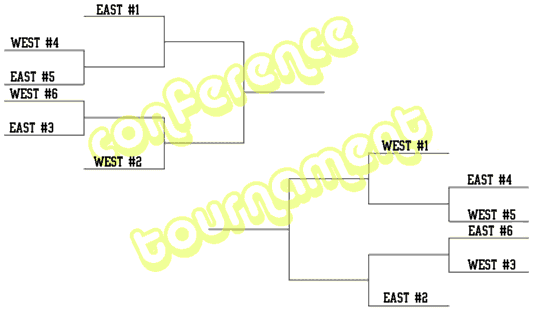
Q: How frequently are Conference Tournament games played?
A: Just like the regular season, each round of the conference tournament will be played over a 4 day period - starting with 12 teams, ending with a Conference Champion.
Post Season
Q: Do all teams play in the National Tournament?
A: No, each conference tournament winner will receive an automatic bid to the tournament. The rest of the 64 team slots are filled with at-large bids. In Division III, there are 32 automatic bids and 32 at-large bids. In Division II, there are 23 automatic bids and 41 at-large bids. In Division I, there are 27 automatic bids and 37 at-large bids.
Q: If we don't get a bid to the National Tournament, will there be a secondary (NIT) type of tournament?
A: Yes, there is now a PostSeason Invitational tournament for each division. The next best 32 teams which do not receive a bid for the National Tournament will get a bid for the PostSeason Invitational.
Q: Are all postseason games played at a neutral site?
A: All National Tournament games are played at neutral sites. In the PostSeason Invitational, the first 3 rounds are played at the home team's court and the final 2 rounds are at neutral sites.
Q: How are the at-large bids for the National Tournament determined? What about the seeding?
A:
National Tournament selection and seeding both rely on the same logic.
The logic for ranking teams for the postseason essentially calculates a score for each game on the team's schedule. This game score is determined by the following components:
- Result (win or loss)
- RPI rank of the opponent
- Top 25 rank of the opponent (this rank is actually calculated and used for all teams, even beyond the top 25)
- Score margin of the game
- Location (home, away, or neutral court)
There is also consideration given to record over the final 10 games as well as conference tournament performance.
Once the tournament field has been determined, then the seeding process will begin, using the same evaluation logic. Some teams may be moved slightly in order to avoid same-conference match-ups early in the tournament.
Once the National Tournament bids have been handed out, the PostSeason Invitational teams are selected using the same process.
Note: teams must have a minimum of .500 win% to qualify for National Tournament at-large bids and a minimum .425 win% to qualify for the Postseason Invitational.
Q: How frequently are National Tournament games played?
A: Just like the regular season, tournament games are played each day. The PostSeason Invitational will last 5 days and the National Tournament will last 6 days, ending with a National Champion.
Q: If my school doesn't win our conference tournament, how will we know if we receive a bid to a postseason tournament?
A: In your office, you will receive an email indicating that you've received a bid to either the National Tournament or the PostSeason Invitational, along with your seeding and region that you'll be playing in.
Q: Why is there such a big discrepancy between my RPI and my seed in the national tournament?
A:
Tournament seeding is not directly based on RPI or SOS. Often a team can have a high RPI without actually having many impressive wins.
For full details on what goes into selection and seeding, reference article #352.
Practice
Q: Do players practice in the off-season? Should I see any ratings improvements based on practice times?
A: There are no formal practices in the off-season - as regulated by the WCAA. Some players may choose to sit on the couch all summer and not practice at all. The majority of a player's improvement comes during the season.
Q: During the off-season, does the amount of time you put into individual categories (i.e. rebounding, passing, etc) play into how much a player's skills may improve / diminish during the break between seasons?
A: Since teams can't hold practices during the off-season, your practice settings have no impact on off-season improvements.
Q: What's the minimum time I need to practice an area so a player's rating won't go down?
A: The rule of thumb is about 7 minutes for most areas, but about half that much for Perimeter and Low Post.
Q: How do player ratings change? What about work ethic?
A:
Practicing certain areas of a player's game will help them improve in certain related skills. See the following table for a list of how each area may impact a player's game:
| Practicing... | Attempts to Improve... |
|---|
| Conditioning | Stamina and athleticism, particularly important for pressing defenses and fast-break offenses. Also helps to improve speed, shot blocking, and durability. |
| Footwork | Defense and shot blocking. |
| Passing | Passing, which is especially important in "set" offenses such as the Motion, Triangle and Flex. Can lead to decreased turnovers on offense. |
| Low Post | Improves finishing skills close to the basket. |
| Perimeter | Improves mid-range to long-range shooting skills. |
| Dribbling | Ball handling - decreases turnovers. |
| Free Throw Shooting | Free Throw Shooting |
| Rebounding | Rebounding |
| Study Hall | GPA |
Work ethic does not change based on practice minutes. It will change based on playing time and starts.
With regards to the offenses and defenses, the more practice and playing time a player receives under each set, the better the offense will function with regards to efficiency, and the same holds true on defense. If you have 5 Seniors who have been practicing your offense and defense for 4 years, you'll have a very "smart" team on the floor. Whereas if you try to switch your offense and/or defense in mid-season, many players will have to spend time learning the new system which can lead to poor shot selection, unforced turnovers, and missed assignments on defense.
Q: Can players ratings go down?
A: Possibly - it depends on how much time you spend practicing different skills, and whether or not a player has been injured.
If you don't practice an area enough, player ratings can go down. Also, injured players may see skills decline depending on the extent of the injury.
Q: Do you still have to give red-shirts study hall minutes?
A: No, ineligible players and red-shirted players still practice with the team, but they don't dress. However, you have to remember that the cumulative gpa must be above 2.0 - so it could have negative impact down the road.
Q: How do I know how much study time to give someone?
A:
Each player is different, but the general rule of thumb is that the closer a players GPA is to 2.0, the more study hall time he'll need to stay eligible. Also, the more important role he plays on your team, the more you'll want to try to ensure he makes the 2.0 GPA cutoff. Heavy study hall minutes do NOT guarantee a player will be eligible. It just improves the odds of eligibility.
You'll receive mid-term academic progress reports on each player, so it may be necessary to adjust study hall minutes at that time.
Rankings
Q: What is the RPI?
A:
The RPI (Rating Percentage Index) is a measure of strength of schedule, and how a team does against that schedule. It does not consider margin of victory. It is used by the WCAA as one of the factors in deciding which teams to invite to the National Tournament and where to seed them.
The basic formula is 25% team winning percentage (WP), 50% opponents' average winning percentage (OWP), and 25% opponents' opponents' average winning percentage (OOWP). When calculating winning percentage (WP), the RPI weights a road win as 1.4 x a normal win, a home loss as 1.4 x a normal loss, a road loss as 0.6 x a normal loss and a home win as 0.6 x a normal win - neutral site games are not adjusted (weighted at 1.0).
Q: What is SOS?
A: SOS stands for strength of schedule. It's calculated as 67% opponents' winning percentage (OWP) and 33% opponents' opponents' winning percentage (OOWP) - the same ratio as in the RPI formula.
Q: Why isn't the RPI and SOS updated until after game #7?
A: The RPI and SOS may be significantly skewed early in the season because there are so few games to base them on. The RPI is primarily a measurement of strength of schedule, and how the team did against that schedule. Each season stands on its own. There are no preseason expectations - everyone starts at zero. Consequently, the numbers could be really skewed early in the season because teams have played so few games. For example, a team can be 2-0, but its opponents haven't played anyone else yet, so its strength of schedule is 0. That's 75% of the formula, so the team won't be rated very highly. After game #7, enough games have been played to start to give a realistic view of RPI and SOS.
Q: How are the Top 25 rankings determined?
A:
Top 25 rankings are based on a combination of talent and game results. The "talent" portion is calculated by looking at the skill ratings of players (excluding Work Ethic, Stamina, and Durability), with more weight given to a team's top 5 players. The "game results" portion is based on opponent rank, score margin, and result (win or loss) for each completed game.
Before the season starts, all weight is placed on talent - and then as the season progresses, more and more weight is placed on game results. By the end of the season, almost all of the weight is on game results.
There may be significant movement of teams early in the season because there are so few games, but as the season moves along, the best teams will rise to the top.
Awards
Q: How are conference player awards determined?
A:
Conference awards are based on stats accumulated during conference games. Each award has its own factors for determination as indicated below.
Player of the Year: Scoring, Scoring Efficiency, Steals, Assists, Blocks, Rebounds, Turnovers, Fouls, Team Success
Defensive Player of the Year: Steals, Blocks, Fouls, Defense Rating
All-Conference: Same as Player of the Year
Freshman of the Year: Same as Player of the Year, but only including freshmen
Q: How are national player awards determined?
A:
National awards are based on stats accumulated during the entire season. Each award has its own factors for determination as indicated below.
Player of the Year: Scoring, Scoring Efficiency, Steals, Assists, Blocks, Rebounds, Turnovers, Fouls, Team Success
Defensive Player of the Year: Steals, Blocks, Defense Rating
Freshman of the Year: Same as Player of the Year, but only including freshmen
All-American: Same as Player of the Year
Q: How is the National Coach of the Year Award winner determined?
A: Voting for the National Coach of the Year is based on numerous factors. Voters look at the success of each program (success is based on conference results, RPI, national ranking, and postseason results) for the current season.
Q: How is the Conference Coach of the Year Award winner determined?
A: Voting for the Coach of the Year (COY) is based on numerous factors. Voters look at the success of each program (success is based on conference record, RPI, and national ranking) for the current season. In addition, they also look at the relative success of the program this season versus last season. For example, a team that finished at 25-1 and won the conference after compiling a 24-2 record the year prior, may not be as impressive to voters as the team that finished at 22-4 but was 10-16 last season.
Grades
Q: How much study hall does it take to keep a kid academically eligible?
A: There's no way to guarantee a passing grade, but you can increase study hall time to maximize the odds of a player qualifying. Each kid is different, but giving him study hall time when he's already in trouble may be a case of "too little too late". Also, study hall minutes are cumulative over the course of a grade period. For example, having 10 minutes there for the entire grade period is about twice as helpful as having 0 minutes until mid-terms and then putting in 10 minutes. So be careful with a strategy of skimping on minutes until you see what mid-term grades are.
Q: What happens if one of my players becomes academically ineligible?
A: You'll lose the player for the next semester (he'll still be on the roster and be able to practice, but can't play in games). If his cumulative GPA is still not above 2.0 at the end of the next semester, he'll be academically ineligible for another semester. In addition, each time you lose a player to academics, your reputation will take a hit.
Q: How many academic terms are there per season?
A: There are 2 academic terms per season. You'll receive a mid-term report around game 6, then the final grades will be posted around game 12 for the first term. Around game 18 you'll receive another mid-term report and around game 24 you'll receive final grades for the 2nd term. Cumulative grades will be updated after the final grades are posted for each term.
Q: If a player finishes the season with less than a 2.0 GPA, will be eligible for next season?
A: Yes. The player will be enrolled in summer school to bring his GPA up to 2.0 - of course you'll see much less improvement in the off-season for that player and he may actually get worse based on how much time he'll be in class over the summer.
Q: Do I have to worry about a player's grades? Can they become academically ineligible?
A: Yes, players can lose their eligibility for a semester if their cumulative GPA drops below 2.0, or if their grades for that term are below 2.0. To make sure a player doesn't become academically ineligible, make sure they are receiving plenty of study hall time (see the practice plan).
Statistics
Q: What are all the statistics listed in a game boxscore?
A:
There are a number of statistics listed in a boxscore for a particular game.
| Abbr | Description |
|---|
| PTS | Points |
| FG | Field Goals |
| FG3 | 3 Point Field Goals (subset of FG) |
| FT | Free Throws |
| OFF REB | Offensive Rebounds |
| REB | Rebounds |
| AST | Assists |
| TO | Turnovers |
| STL | Steals |
| BLK | Blocks |
| PF | Personal Fouls |
| PIP | Points in the Paint |
| POT | Points off Turnovers |
| SCP | Second Chance Points |
| FBP | Fast Break Points |
| BP | Bench Points |